
7 min read
If you have ever wanted to invest in the stock market but felt lost choosing between thousands of companies, an ETF may be the answer. An ETF, short for exchange-traded fund, lets you own a small piece of many investments through a single purchase. This guide explains what an ETF is, how it works, the main types, the costs, the risks, and how you can buy one.
What Is an ETF?
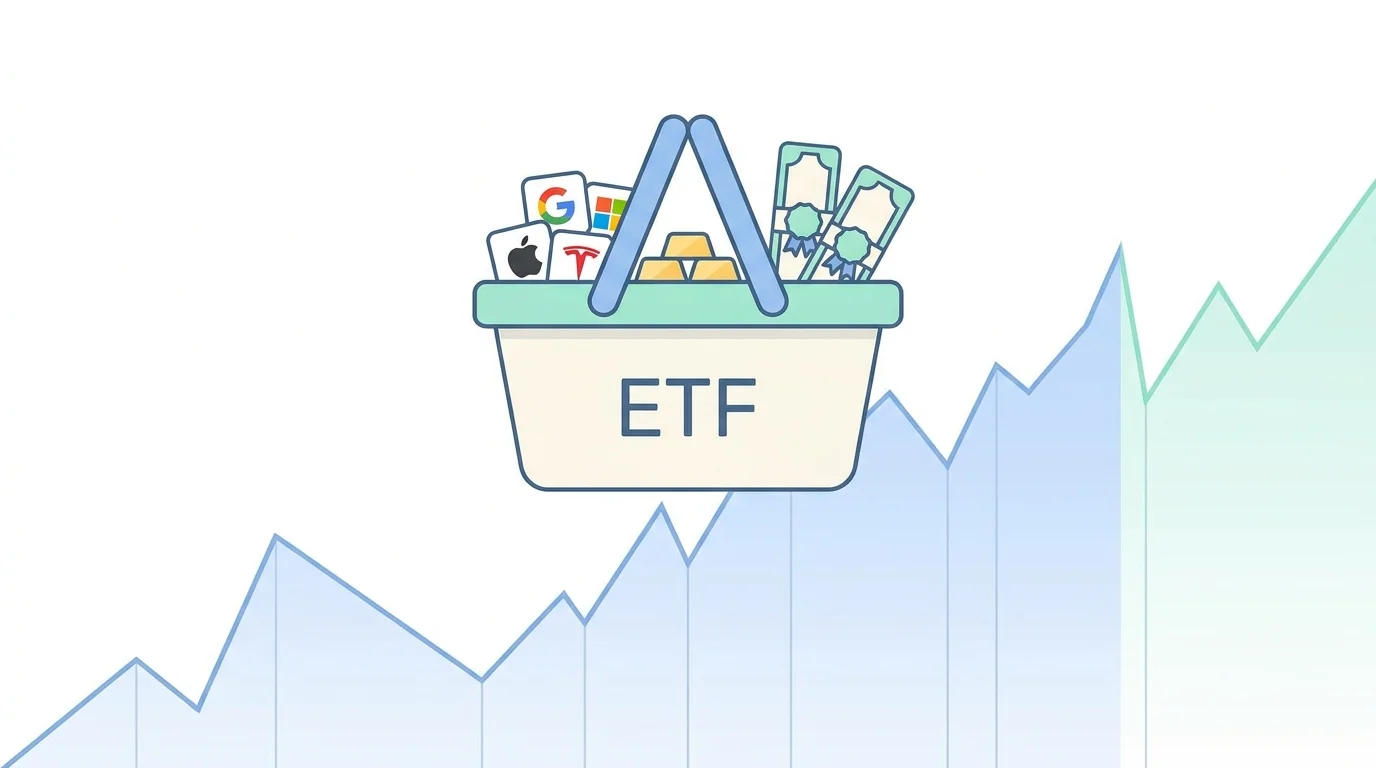
An exchange-traded fund is an investment fund that holds a collection of assets, such as stocks, bonds, or commodities, and trades on a stock exchange just like an individual company share. When you buy one share of an ETF, you indirectly own a slice of every asset inside the fund.
For example, an ETF that tracks a major stock index holds shares of all the companies in that index. Instead of buying 500 stocks one by one, you buy one ETF share and get exposure to all of them at once.
The first ETF in the United States, the SPDR S&P 500 ETF, launched in 1993. Since then, thousands of ETFs have appeared, covering everything from global stocks to gold, government bonds, and specific industries.
How Does an ETF Work?
An ETF is created by a fund company, called the issuer. The issuer decides what the fund will hold and what goal it will follow. Most ETFs are passive, meaning they simply copy an index. Others are actively managed, where a fund manager picks investments to try to beat the market.
The share price of an ETF moves throughout the trading day as buyers and sellers trade it on the exchange. This is different from a traditional mutual fund, which is priced only once at the end of the day.
Behind the scenes, large financial institutions known as authorized participants help keep the ETF’s market price close to the actual value of its holdings. They create new ETF shares or redeem existing ones in large blocks, which keeps supply and demand balanced.

Main Types of ETFs
Not all ETFs are the same. Here are the most common categories.
Stock ETFs hold shares of companies. Some follow a broad market, while others focus on a country, company size, or investing style like growth or dividends.
Bond ETFs hold government or corporate bonds. They are popular with investors who want regular income and lower price swings than stocks.
Commodity ETFs give exposure to assets like gold, silver, or oil, either by holding the physical metal or through futures contracts.
Sector and industry ETFs focus on one area of the economy, such as technology, healthcare, or energy.
International ETFs invest in companies outside your home country, helping you spread risk across regions.
Thematic ETFs target trends like clean energy, artificial intelligence, or cybersecurity.
Inverse and leveraged ETFs are designed to move against the market or amplify daily moves. They are complex, meant for short-term trading, and generally unsuitable for beginners.
Benefits of Investing in ETFs
Instant diversification. One purchase spreads your money across many companies or assets, which lowers the damage if any single one performs badly.
Low costs. Many index ETFs charge very small annual fees, some below 0.10% of the amount invested. Lower fees mean more of your returns stay with you over the long term.
Flexibility. You can buy and sell during market hours, and you can start with the price of a single share. Many brokers also allow fractional shares.
Transparency. Most ETFs publish their holdings regularly, so you can see exactly what you own.
Tax efficiency. In many countries, the way ETFs are structured can result in fewer taxable events than some mutual funds, although tax rules differ by country.
Risks You Should Know
ETFs are simpler than picking individual stocks, but they are not risk-free.
Market risk. If the market or sector the ETF tracks falls, the value of your ETF falls too.
Tracking error. An ETF may not perfectly match its index because of fees and trading costs.
Liquidity risk. Small or niche ETFs may have fewer buyers and sellers, which can widen the gap between the buying and selling price.
Concentration risk. A sector or thematic ETF can be heavily tied to one industry, so a downturn there can hit hard.
Complex products. Leveraged and inverse ETFs can lose value quickly and are not designed for long-term holding.
ETF vs Mutual Fund vs Individual Stock
An individual stock represents ownership in a single company, so its success depends on that one business. A mutual fund pools money from many investors and is usually bought or sold at a price set once per day. An ETF combines the diversification of a fund with the easy trading of a stock.
In general, ETFs tend to have lower fees than actively managed mutual funds and offer more trading flexibility. Mutual funds may still suit people who prefer automatic monthly investing through a fund company.
What Does an ETF Cost?
The main ongoing cost is the expense ratio, a yearly percentage taken from the fund’s assets. If an ETF has an expense ratio of 0.20%, you pay about $2 per year for every $1,000 invested.
You may also face brokerage commissions, though many platforms now offer commission-free ETF trading. Another hidden cost is the bid-ask spread, the small difference between the price buyers offer and sellers ask.
How to Start Investing in ETFs
Step 1: Set your goal. Decide whether you are investing for retirement, a major purchase, or steady long-term growth. Your timeline shapes which ETFs make sense.
Step 2: Open a brokerage account. Choose a licensed and regulated broker available in your country. Compare fees, ease of use, and the ETFs offered.
Step 3: Research ETFs. Look at the expense ratio, what the fund holds, its size, how long it has existed, and how closely it tracks its index.
Step 4: Decide how much to invest. Only invest money you will not need in the short term, and consider investing a fixed amount regularly instead of all at once.
Step 5: Place your order. Search for the ETF’s ticker symbol, choose the number of shares, and select a market order or a limit order. A limit order lets you set the maximum price you are willing to pay.
Step 6: Review occasionally. Check your portfolio once or twice a year, and rebalance if your mix has drifted far from your plan. Avoid reacting to daily price noise.

Who Are ETFs Best For?
ETFs suit beginners who want a simple start, busy people who prefer a hands-off approach, and experienced investors who want to build a low-cost core portfolio. They are also useful for gaining exposure to areas that are hard to access directly, such as foreign markets or commodities.
Also Read Finance Blog Here: What Is a Special Purpose Vehicle (SPV)? Meaning, Structure, Types and Examples
Final Thoughts
An ETF is one of the simplest ways to build a diversified portfolio without picking individual winners. Its low costs, easy trading, and wide variety make it a popular choice worldwide. Still, no investment is guaranteed, so understand what your ETF holds, keep costs low, and invest with a long-term mindset.

Stephen D. Schmitt is the founder and lead writer at Her Net Worth Journey. He created the site to make personal finance easier to understand and easier to act on, without the jargon that makes most money advice hard to follow. Stephen focuses on practical, number-driven guidance — the kind of advice a reader can apply the same day they read it. He writes about budgeting, investing, saving, and debt from a simple starting point: track the number, then make decisions that move it in the right direction. Stephen lives in Maitland, Florida, and manages Her Net Worth Journey directly, from the content to the free tools on the site.
1 thought on “What Is an ETF? A Complete Beginner’s Guide”