
10 min read
Large financial deals rarely sit inside the main company’s books. A property developer, a bank or a tech startup will often park a risky asset, a big project or a pool of loans inside a separate legal entity built just for that job. That entity is a special purpose vehicle, usually shortened to SPV.
If you have seen terms like SPE, SPC, off-balance-sheet financing or securitization, you have already met the SPV idea from another angle. This guide explains what a special purpose vehicle is, how it is built, where it is used, and what can go wrong with it.
What Is a Special Purpose Vehicle?
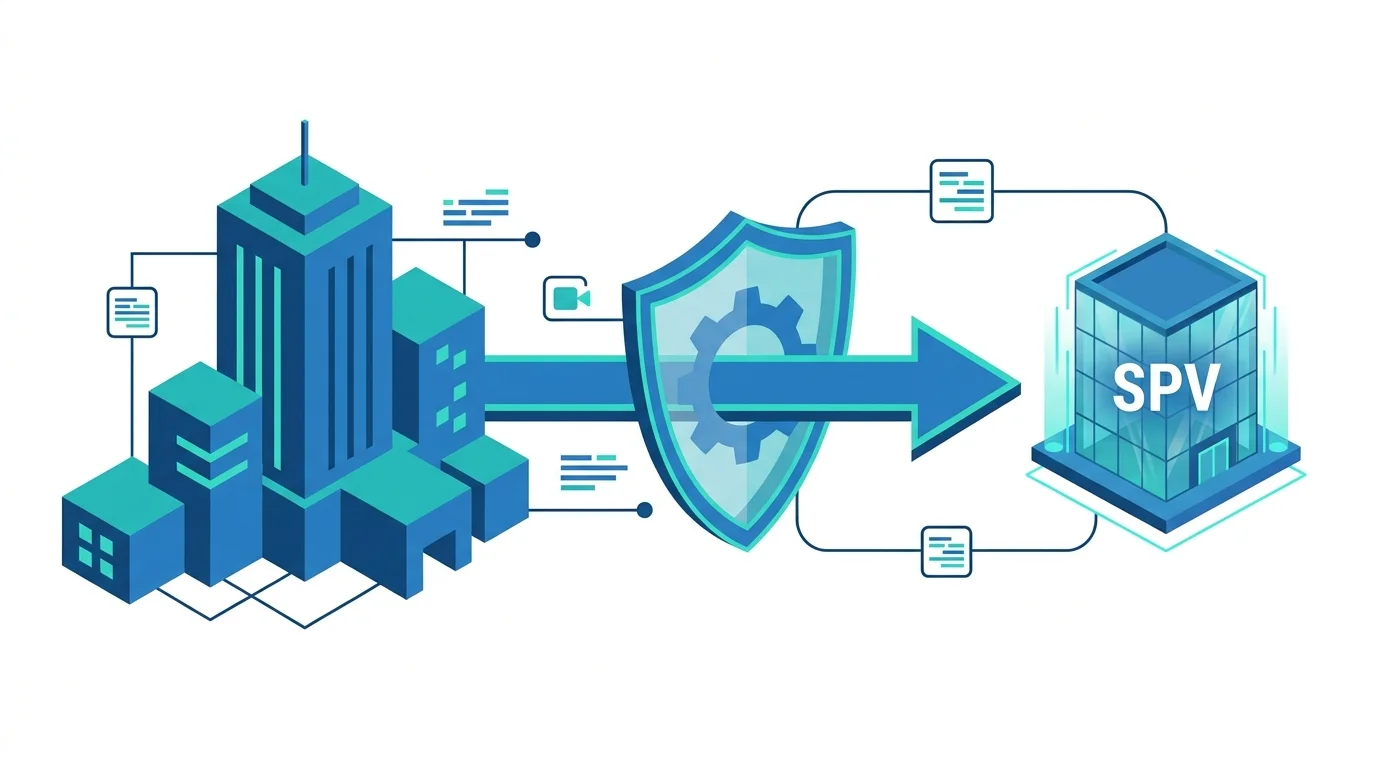
A special purpose vehicle is a separate legal entity, most often a company, limited partnership or trust, created to carry out one narrow objective. That objective might be holding a set of assets, financing a single project, or isolating a specific risk from the rest of a business.
The company that sets it up is called the sponsor or originator. The SPV owns its assets and liabilities on its own account, so its finances stay legally apart from the sponsor’s. In many jurisdictions it is also called a special purpose entity (SPE), and in a few structures a special purpose company (SPC).
The main idea is separation. If the project inside the SPV fails, creditors can usually claim only against what the SPV holds, not against the parent company’s other assets. If the parent goes bankrupt, the assets inside the SPV are generally protected from the parent’s creditors. This is often described as being “bankruptcy remote.”
How an SPV Works
Every SPV deal has its own details, but most follow the same basic path:
- The sponsor identifies a purpose. This could be a toll road, a pool of car loans, a real estate development or a single investment.
- The SPV is incorporated. Its founding documents restrict what it may do. It cannot wander into other businesses, which is what makes lenders comfortable.
- Assets are transferred. The sponsor sells or contributes assets to the SPV. In a true sale, those assets leave the sponsor’s control.
- Funding is raised. The SPV issues bonds, takes loans or accepts equity from investors, using its assets as backing.
- Cash flows are distributed. Income from the assets, such as loan repayments or rent, goes first to the SPV’s lenders and then to its equity holders.
- The SPV winds down. Once the project ends or the debt is repaid, the entity is dissolved.
Many SPVs are run by an independent trustee or administrator rather than by the sponsor’s own staff, which strengthens the argument that the entity is truly separate.
Key Features of a Special Purpose Vehicle
- Narrow purpose: Its charter limits it to a defined activity.
- Legal separation: It has its own name, contracts, bank accounts and liabilities.
- Ring-fenced assets: Assets and debts are contained so problems do not spread easily.
- Limited life: Many SPVs exist only until a project or deal finishes.
- Minimal operations: It often has no employees and outsources administration.
- Independent governance: Directors or trustees are sometimes unconnected to the sponsor.
Why Companies Use SPVs
Risk isolation. A company that wants to try a risky venture, such as a mine or a new energy plant, can hold it in an SPV so a failure does not threaten the core business.
Cheaper financing. Investors in an SPV look at the quality of the assets inside it rather than the credit rating of the whole parent. A strong pool of assets can therefore raise money at lower interest rates than the parent could get on its own.
Shared ventures. Several companies can jointly own one SPV to build or operate something together, each holding a defined share, without merging their businesses.
Asset transfer and structuring. SPVs make it easier to sell, pledge or transfer a specific asset, such as a building, without touching the rest of a company.
Regulatory and accounting treatment. In some cases, assets and debts held by an SPV may be kept off the sponsor’s balance sheet, although modern accounting rules have tightened this considerably.
Investor access. Angel groups and venture syndicates often pool many small investors into one SPV that holds a single stake in a startup. The startup then sees only one line on its ownership table instead of dozens.
Common Types and Uses of SPVs
Securitization vehicles. A bank bundles mortgages, credit card receivables or auto loans and sells them to an SPV. The SPV issues securities to investors, and borrowers’ repayments pay those investors.
Project finance SPVs. Infrastructure such as power plants, highways and airports is usually built by an SPV that owns the project and borrows against its future revenue.
Real estate SPVs. A developer or fund places each property in its own entity, so a lawsuit or default on one building does not touch the others.
Sukuk and bond issuers. Governments and corporations issuing Islamic bonds usually do so through an SPV that holds the underlying assets on behalf of investors. Pakistan’s international sukuk issuances follow this model.
Venture and investment syndicates. Investors pool money in an SPV that buys a stake in one company.
Joint venture vehicles. Two or more firms create a shared entity for a single collaborative project.
A Simple Example
Suppose a construction company wants to build a solar farm that costs 100 million dollars. Financing it directly would load its own balance sheet with debt. Instead, it creates SolarCo SPV, contributes 20 million in equity, and lets SolarCo borrow the remaining 80 million from banks. The banks lend against the farm’s expected electricity sales.
If power prices collapse, SolarCo may default and the banks may take the farm, but the parent’s other projects remain untouched. The banks knew this when they lent, and they priced the loan accordingly.

Real-World Cases: The Good and the Bad
SPVs are not suspicious by nature. Most mortgage-backed financing, airline aircraft leasing and large infrastructure deals depend on them. But two events show how they can be abused.
Enron (2001). The American energy company used a web of special purpose entities to move debt off its books and to book profits that did not exist economically. When the structure collapsed, Enron went bankrupt and investors lost billions. The case led to the Sarbanes-Oxley Act of 2002, which tightened disclosure of off-balance-sheet arrangements.
The 2008 financial crisis. Banks used vehicles, including structured investment vehicles, to hold mortgage-linked securities away from their main balance sheets. When housing prices fell, losses returned to the sponsoring banks anyway, because many had implicit or contractual commitments to support these entities. The episode showed that legal separation does not always mean real economic separation.
SPV vs Subsidiary vs SPAC vs Holding Company
| Feature | SPV | Regular Subsidiary | SPAC | Holding Company |
|---|---|---|---|---|
| Purpose | One narrow objective | General business operations | Acquire a private company through a public listing | Own shares in other companies |
| Typical lifespan | Limited | Indefinite | Usually about 2 years to complete a deal | Indefinite |
| Operations | Minimal | Full business | None until a merger | Usually none |
| Main goal | Risk isolation and financing | Business expansion | Taking a company public | Group control |
A SPAC (special purpose acquisition company) is sometimes confused with an SPV. A SPAC is a listed shell company that raises money from the public in order to buy a business later, while an SPV is usually a private structure built around specific assets.
Advantages of Using an SPV
- Protects the parent from project-specific losses
- Can lower borrowing costs through asset-backed financing
- Makes joint ventures and co-investments cleaner
- Simplifies the sale or transfer of a single asset
- Lets many investors participate through one entity
- Gives lenders a clear, contained set of assets to rely on
Risks and Disadvantages

- Setup and running costs: Legal fees, audit costs and administration add up, especially for small deals.
- Complexity: Layered structures are hard for outsiders to understand, which can hide real exposure.
- Reputational risk: After Enron, heavy use of SPVs can raise suspicion among investors and regulators.
- Consolidation rules: If the sponsor effectively controls the SPV, accounting rules may force the sponsor to include it in its financial statements anyway.
- Legal challenge: A court can ignore the separation, sometimes called piercing the corporate veil, if the SPV is a sham or is used to defraud creditors.
- Limited flexibility: Because the charter is narrow, changing course later can be difficult.
Regulation and Accounting Treatment
After the Enron scandal, accounting standard-setters closed many loopholes. In the United States, rules on variable interest entities require a company to consolidate an SPV when it holds the main economic risks and rewards of that entity. Under IFRS, the standard on consolidated financial statements takes a similar approach based on control. Securities regulators also require disclosure of significant off-balance-sheet arrangements.
Jurisdiction matters too. Sponsors often choose places such as Delaware, the Cayman Islands, Luxembourg, Ireland or the Netherlands because their laws are predictable, their courts are experienced with structured finance and their tax treatment is clear. In Pakistan, SPVs appear in sukuk issuance, project financing and real estate investment trust structures, and they fall under company law and securities regulator rules.
How to Set Up an SPV
- Define the exact purpose and expected lifespan.
- Choose the legal form: company, LLP or trust.
- Select a jurisdiction based on law, tax and investor expectations.
- Draft founding documents that limit the entity’s activities.
- Appoint directors or trustees, ideally including independent ones.
- Open bank accounts and arrange accounting and audit.
- Transfer the assets and complete the funding arrangements.
- Keep records separate and avoid mixing money with the parent.
Anyone doing this should work with a qualified lawyer and tax adviser, since a badly built SPV can fail to give the protection it promises.
Also Read Finance Blog Here: Portfolio Manager: What They Do, What They Earn, and How to Become One
Frequently Asked Questions
Is an SPV legal?
Yes. It is a normal, lawful tool used worldwide. Problems arise only when it is used to hide liabilities, mislead investors or avoid legal duties.
Does an SPV have employees?
Often it does not. Administration is usually outsourced to a trustee or corporate services provider.
Can an individual investor use an SPV?
Yes. Investment syndicates commonly use SPVs so several people can invest in one deal together.
What is the difference between SPV and SPE?
In practice the terms are used almost interchangeably. SPE is common in accounting language, while SPV is more common in finance and deal-making.
Are SPVs the same as shell companies?
Not exactly. An SPV has a defined business purpose and holds real assets, while a shell company may exist only on paper, though SPVs can look like shells until they are funded.
Conclusion
A special purpose vehicle is a purpose-built legal entity that separates a specific asset, project or risk from the rest of a business. Used properly, it lowers financing costs, protects parent companies and lets investors join deals they could not access alone. Used carelessly or deceptively, it can conceal risk, as Enron and the 2008 crisis showed. Understanding what an SPV is, and what it can and cannot protect, helps entrepreneurs, investors and students judge these structures with clear eyes.

Stephen D. Schmitt is the founder and lead writer at Her Net Worth Journey. He created the site to make personal finance easier to understand and easier to act on, without the jargon that makes most money advice hard to follow. Stephen focuses on practical, number-driven guidance — the kind of advice a reader can apply the same day they read it. He writes about budgeting, investing, saving, and debt from a simple starting point: track the number, then make decisions that move it in the right direction. Stephen lives in Maitland, Florida, and manages Her Net Worth Journey directly, from the content to the free tools on the site.
1 thought on “What Is a Special Purpose Vehicle (SPV)? Meaning, Structure, Types and Examples”